Fraud Detection for Payment Processors
How identity and web intelligence strengthen transaction risk scoring, reduce chargebacks and produce audit-ready evidence.

Fraud detection for payment processors works best as a layered system. Transaction-risk engines score what a payment looks like. Device and behavioural tools assess the session. AML monitoring watches for financial-crime patterns. Identity and web intelligence adds something the others cannot: evidence about who is behind the account – whether the identity is established, consistent and corroborated across independent sources. That evidence helps teams resolve ambiguous cases, investigate faster and give legitimate customers a smoother path.
Key takeaways
- Transaction data describes the event. It cannot always tell you whether a real, consistent identity stands behind it.
- Effective fraud detection platforms combine transaction, device, verification, AML and identity signals, then decide in one place.
- Identity evidence is most useful where transaction scores are uncertain: the grey band that ends up in review.
- The same evidence that surfaces risk can also confirm legitimate customers, which reduces unnecessary friction.
- Explainable, source-backed signals produce risk insights that analysts and auditors can follow.
Why isn’t transaction data enough on its own?
Transaction signals are strong at spotting unusual events: a sudden spike in value, a new merchant category, a burst of attempts from one device. They are weaker when the fraud looks ordinary.
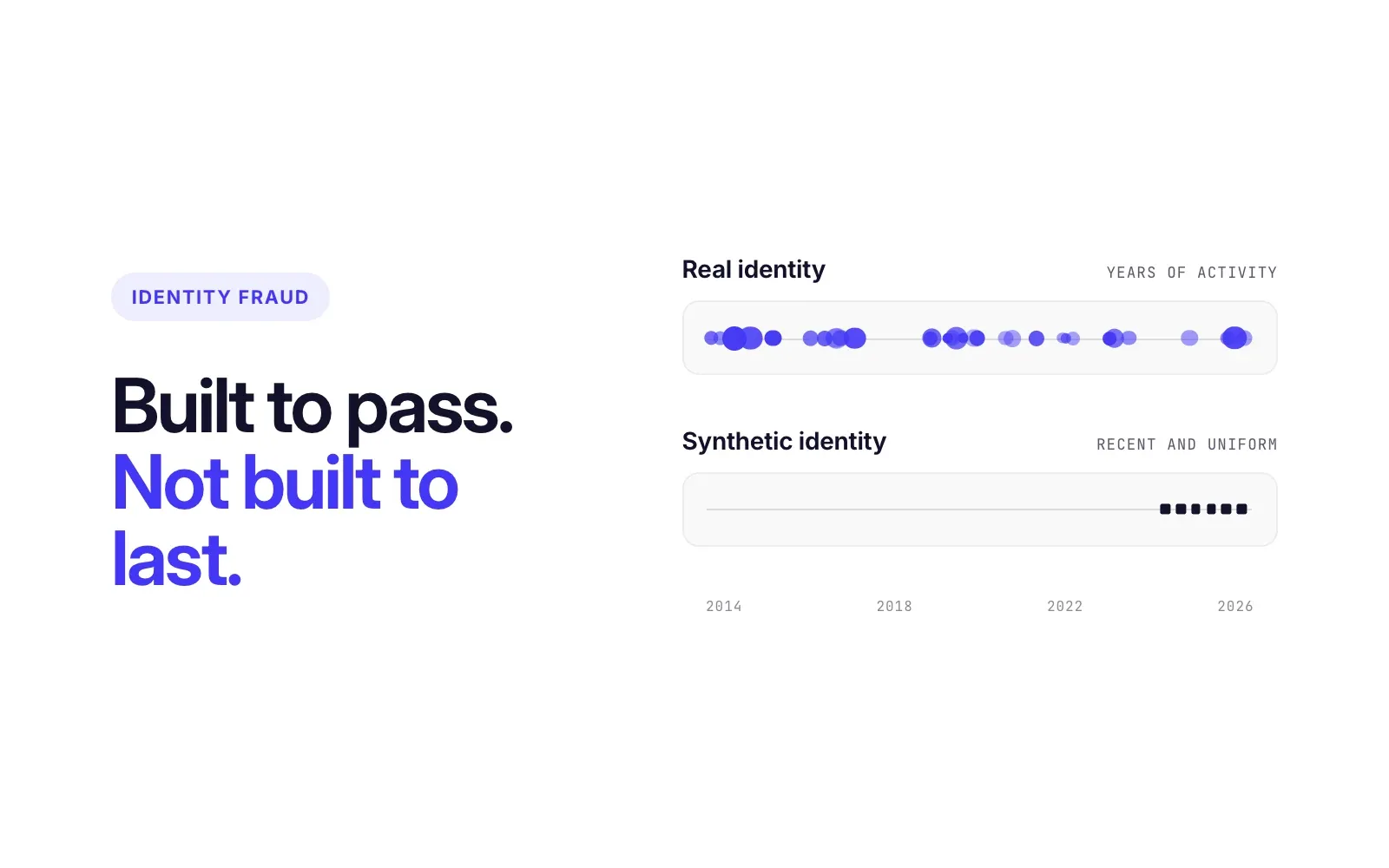
A stolen-but-valid identity or a well-built synthetic identity can produce normal-looking payments for months. A mule account can behave like any other new customer until funds start moving. A scam-linked account can sit between “clearly risky” and “clearly fine” for a long time. In each case the question is not only “does this payment look risky?” but “who is likely behind this account?”
What makes up an effective payment fraud stack?
| Component | What it answers | Typical inputs |
|---|---|---|
| Authorization and network controls | Can this payment be processed? | Issuer authorization, network rules, strong customer authentication |
| Transaction risk scoring | Does this payment look risky? | Amount, velocity, merchant, account history |
| Device and behavioural intelligence | Is this session normal? | Device fingerprint, IP, behavioural biometrics |
| Identity verification | Do the submitted details check out? | Document checks, bureau and registry data |
| AML and sanctions monitoring | Is there financial-crime exposure? | Screening lists, transaction monitoring |
| Identity and web intelligence | Is a real, consistent identity behind this account? | Digital footprint, cross-source consistency, contact-point links, breach exposure |
| Orchestration, case management and feedback | What do we do, and what did we learn? | Decision rules, step-up, analyst review, confirmed outcomes |
Fraud detection platforms bring these components together. The quality of the decision depends less on how many tools are connected and more on whether each one adds evidence the others do not.
How are transaction signals different from identity signals?
Transaction signals describe behaviour in the moment: what was bought, for how much, how fast and from where. They change with every payment.
Identity signals describe the person or business the account claims to be. Do the name, email, phone and address belong together? Has this identity been visible over time? Are its contact details shared with other, unrelated accounts? Do they appear in breach data? These signals change slowly, which is exactly why they help: a fraudster can make a transaction look normal far more easily than they can give a fabricated identity years of consistent history.
A transaction score tells you how a payment looks. Identity evidence tells you who is likely behind it.
Where does Heka fit in the payment fraud workflow?
Heka is not a transaction-monitoring platform. It does not authorize payments, and it does not replace device intelligence, AML monitoring or transaction-risk engines. It adds external identity and web intelligence – a 0–100 score with explainable signals – that your existing decisioning can use alongside its own.
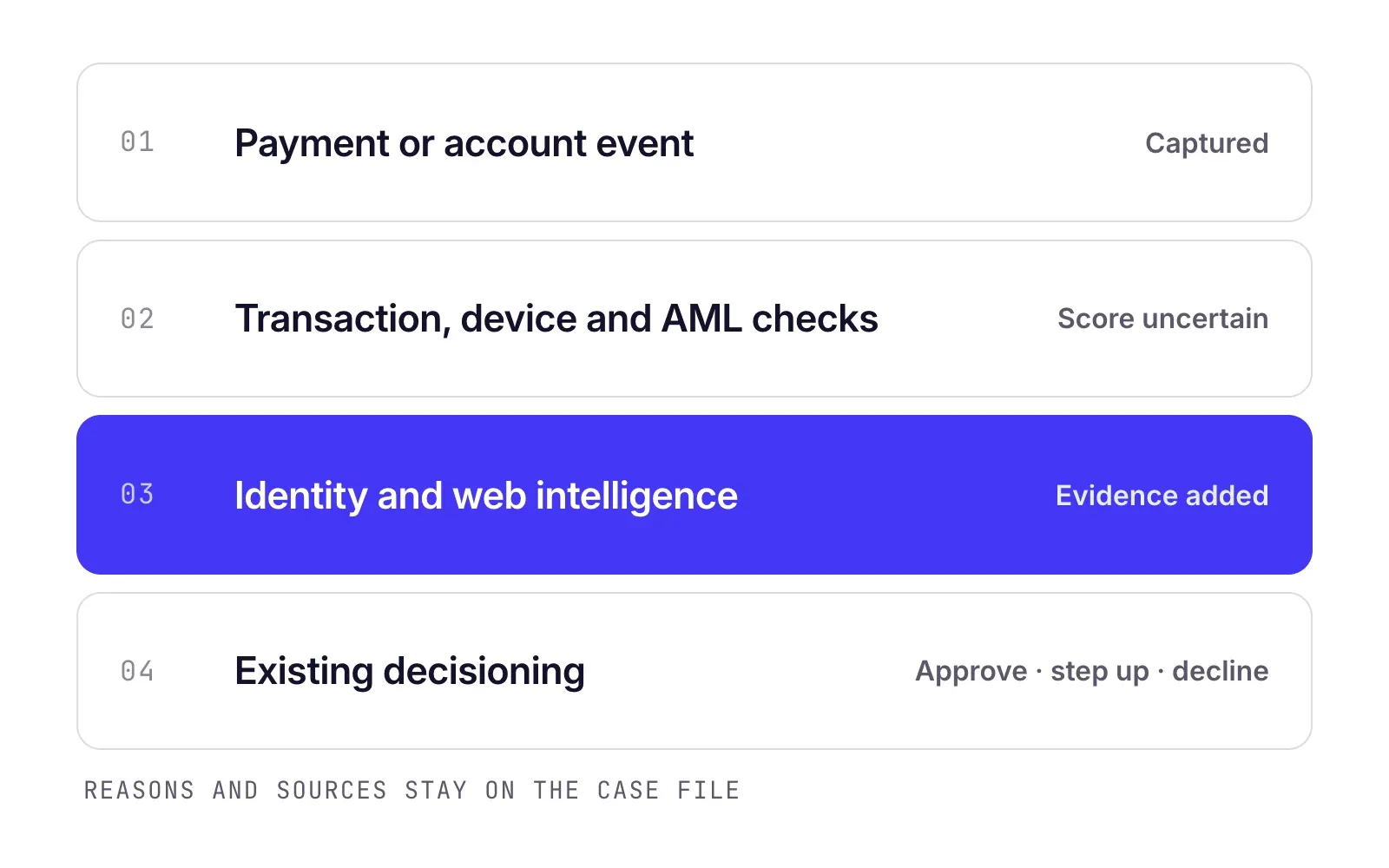
In practice that evidence is most useful at three points:
- Account and merchant onboarding, before risk enters the portfolio
- The review band, where a transaction or account score is too uncertain to approve or decline automatically
- Investigation and case management, where analysts need to understand who they are dealing with
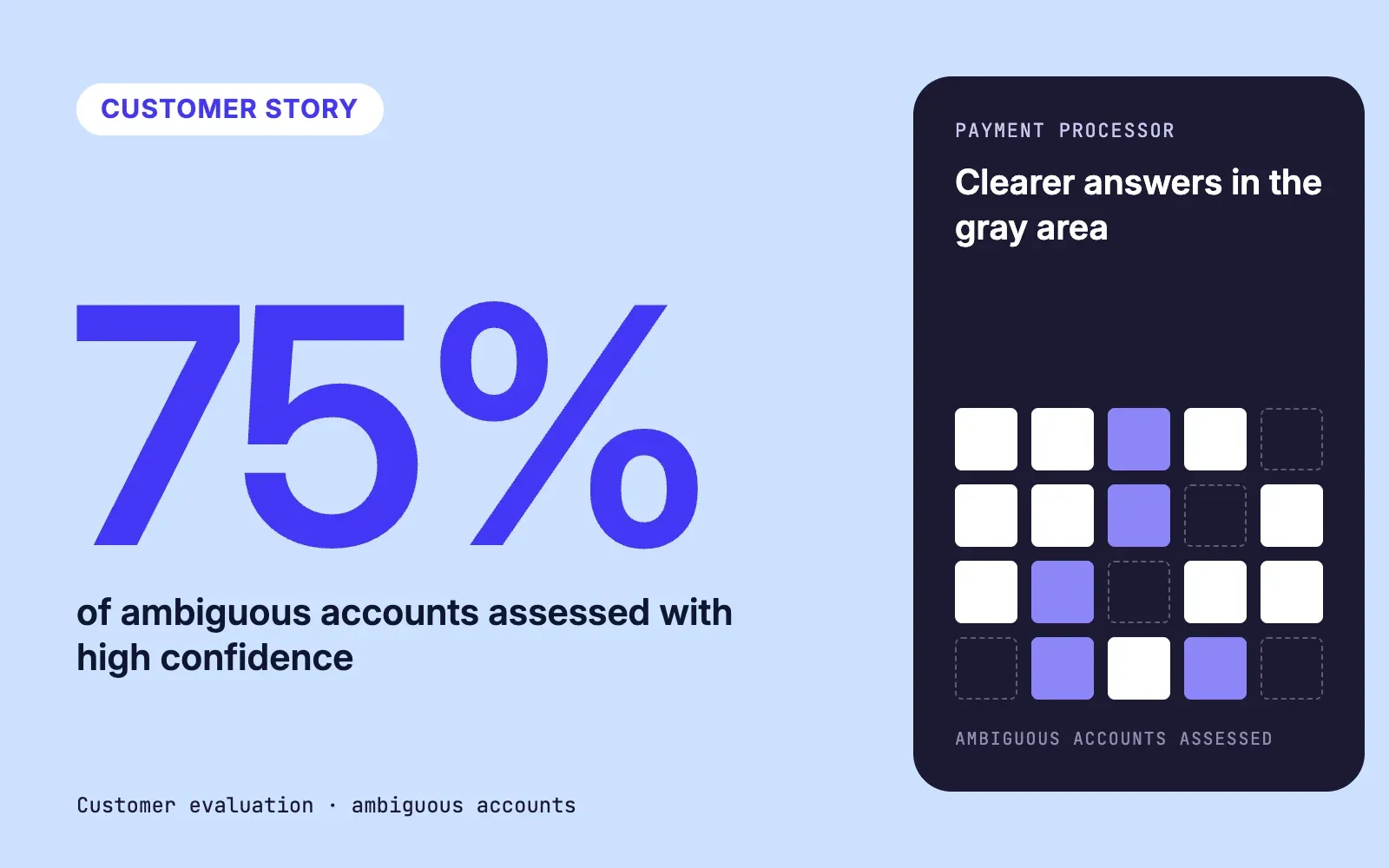
In one evaluation, a payment processor used Heka as additional evidence on accounts its internal scam warnings could not clearly classify. Heka gave a high-confidence assessment for 75% of those ambiguous accounts, and decisions stayed with the processor’s own team. Performance varies by portfolio and use case.
How does identity evidence help teams investigate risk?
A risk score tells an analyst that something is wrong. Identity evidence helps explain what. Explainable signals show which details do not align, which contact points connect to other accounts and whether the identity has a credible history. That turns an open-ended investigation into a focused one.
It also helps teams prioritise. When the evidence is strong in either direction, the case can move quickly. When it is mixed, analysts know where to look first.
How can stronger evidence reduce friction for legitimate customers?
The same intelligence that surfaces risk also confirms legitimacy. An established, consistent identity whose details align across independent sources is less likely to need step-up verification or manual review.
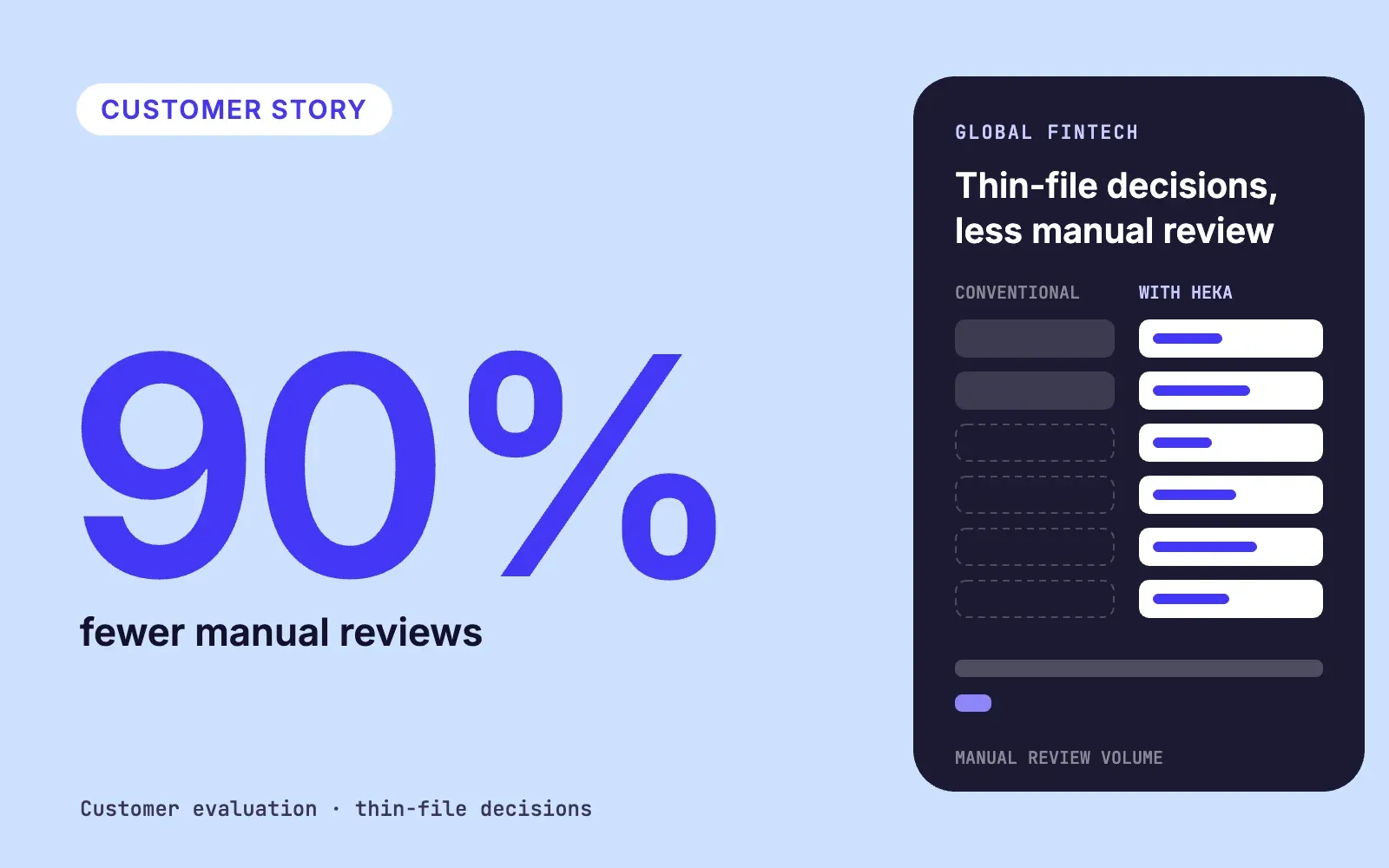
That matters for conversion and for cost. A global payments platform that added Heka’s identity intelligence to its existing controls saw a 90% reduction in manual reviews in its evaluation, while moving legitimate thin-file applicants through faster.
Can identity intelligence reduce chargebacks?
Chargebacks have many causes: stolen credentials, misrepresented identities, first-party misuse, merchant disputes and service problems. Identity intelligence does not settle disputes or replace chargeback management, and it does not prevent chargebacks on its own.
Where chargebacks trace back to fraudulent or misrepresented identities, earlier identity evidence can help. Catching those accounts at onboarding or in the review band means fewer of them reach the point of a disputed payment. Feeding confirmed chargeback outcomes back into models and rules then improves the next decision.
What makes risk insights audit-ready?
An audit-ready insight can be traced back to sources and reasons. It shows what was checked, what was found and why it mattered to the decision.
Explainable identity signals support this directly. Each flag points to the evidence behind it, so case files record more than a score. That helps analysts act with confidence, and it helps risk, compliance and model-governance teams review decisions after the fact.
How should you evaluate fraud detection platforms and identity data vendors?
- Incremental value on your own data. Ask the vendor to score your historical accounts or transactions blind, before seeing outcomes, then compare with confirmed fraud and chargebacks.
- False positives at the same detection rate. More fraud caught is only useful if good customers are not flagged at the same time.
- Explainability. Every output should be traceable to a source an analyst can review.
- Real-time fit. Output should arrive through an API in a structured form, within your latency budget, and plug into your existing decisioning.
- Net-new coverage. Check whether the data adds sources you do not already buy.
- Operational fit. Consider how analysts will see and use the evidence during review.
Questions to ask vendors
- Which part of our payment decision does your output improve, and which parts do you assume other tools cover?
- Scored blind on our history, how many confirmed fraud cases do you surface that our current stack missed?
- How does your output change false positives in our review band?
- Can every signal be traced to its source in a case file?
- How do you integrate with our fraud detection platform and orchestration rules?
Bringing it together
Payment fraud cannot always be understood from transaction data alone. The strongest stacks keep their transaction, device, verification and AML layers, and add identity evidence where those layers are least certain. The result is better decisions in the grey band, faster investigations and less friction for the customers you want to keep.
To see how Heka’s identity intelligence adds net-new signals to your existing controls, explore more resources or book a demo.
Sources · Heka customer evaluations with a payment processor and a global payments platform. Customer evaluation results; performance varies by portfolio and use case.
Frequently asked questions
- How do payment processors detect fraud?
- Most use a layered stack: authorization and network controls, transaction risk scoring, device and behavioural intelligence, identity verification, AML and sanctions monitoring, and case management. Identity and web intelligence adds evidence about who is behind an account, which helps resolve cases the other layers cannot classify.
- What is transaction risk scoring?
- Transaction risk scoring estimates how likely a payment is to be fraudulent from signals such as amount, velocity, merchant, device and account history. It describes the event well but says less about the identity behind it.
- How can payment processors reduce chargebacks?
- Chargebacks have many causes, so no single tool removes them. Fraud-related chargebacks can be reduced by catching fraudulent or misrepresented identities earlier, using identity evidence alongside transaction scoring, and by feeding confirmed outcomes back into models and rules.
- What is real-time payment fraud detection?
- It is scoring and deciding on a payment or account event while it happens, within the time budget of the payment flow. Any added signal source has to return structured output through an API fast enough to fit that budget.
- What are audit-ready risk insights?
- They are risk outputs that can be traced back to specific sources and reasons, so analysts, model-risk teams and auditors can see why a decision was made. An explainable signal is easier to act on and to defend than an unexplained score.
- Does identity intelligence replace transaction monitoring?
- No. Identity intelligence is an additional layer. It strengthens transaction-risk engines, device intelligence, AML monitoring and existing decisioning with evidence about the identity, but it does not authorize payments or monitor transactions itself.