Pension Buyout Pricing: How Member Data Quality Can Affect Your Premium
Learn how member data quality can affect pension buyout pricing, where population-wide screening adds value and how validated findings support insurer decisions.

A pension scheme can have complete administration records and still hold outdated information about its members. For trustees and sponsors approaching an insurance transaction, the next question is commercial: could resolving those gaps change the cost of securing benefits?
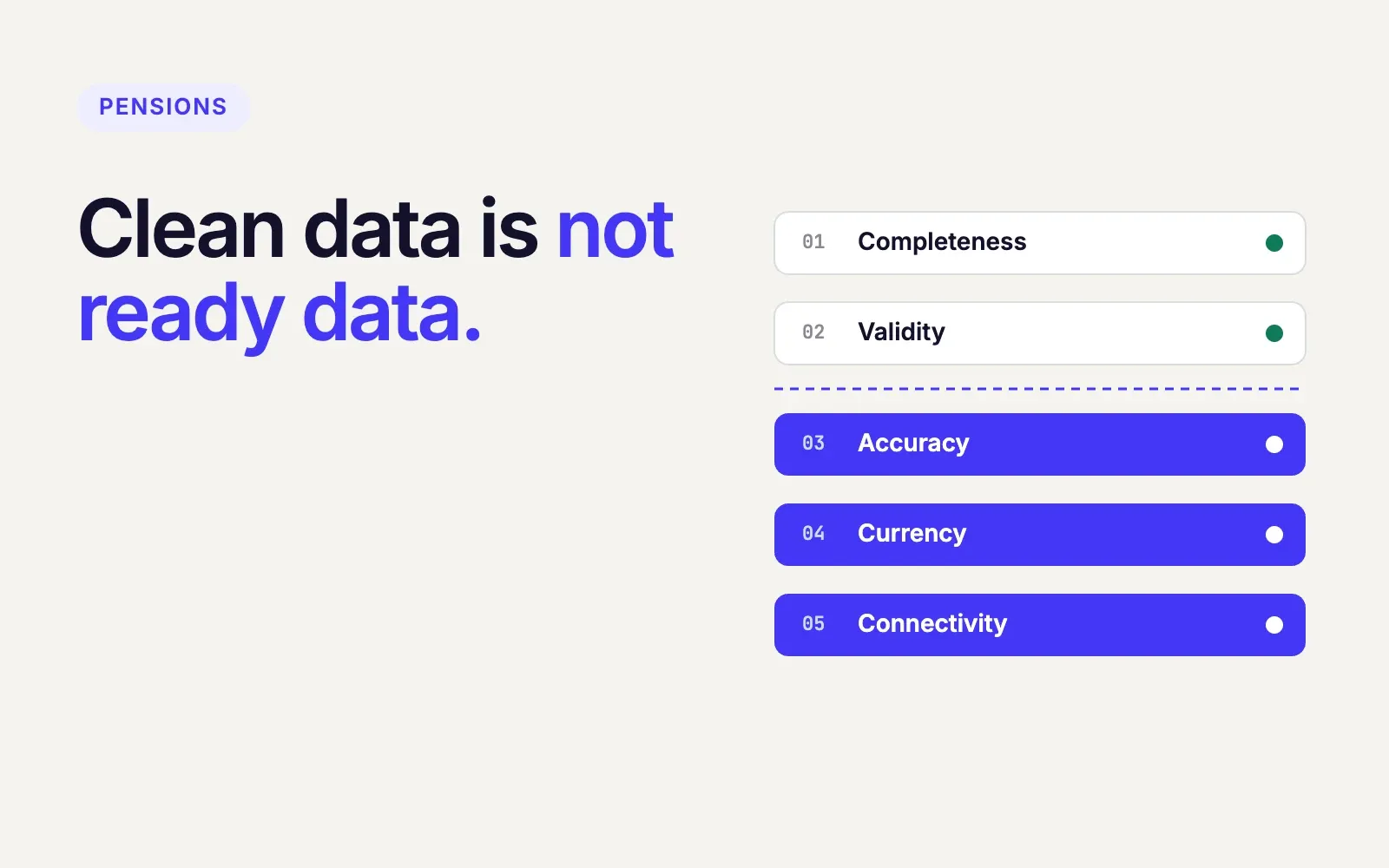
Our previous article explored why clean data may not be buyout ready. This article takes the next step: identifying which member information could matter financially, where population-wide screening adds value and how findings can enter the pricing process.
The starting point is a defined set of questions about the membership, agreed with the administrator and transaction advisers. Screening is valuable when it supplies usable evidence for those decisions.
Key takeaways
Unreported deaths, incorrect dates of birth and incomplete spouse or dependant information can be relevant to the benefits and assumptions being priced. Population-wide screening can surface discrepancies beyond known missing-member cases. Findings must be validated and assessed under the scheme rules and transaction terms before they can affect a premium. The business case depends on financial relevance, additional coverage and the cost of follow-up work.
How can member information affect insurer pricing?
An insurer needs to understand the benefits it is committing to pay and the population covered. Accurate member information helps establish those obligations and supports the assumptions used to assess future payments.
PASA’s guidance on data readiness for buy-in and buyout explains that incomplete or inaccurate data can lead insurers to use prudent assumptions and margins for uncertainty. It identifies mortality screening of deferred members as a way to avoid unnecessary premiums and highlights marital information as relevant to costing liabilities.
There are two opportunities to investigate: correcting information that changes the obligations being insured, and supplying evidence that improves the assessment of uncertain inputs. Neither means that every new data point produces a discount. The insurer’s evidence requirements and pricing approach matter.
Which gaps deserve attention before the transaction?
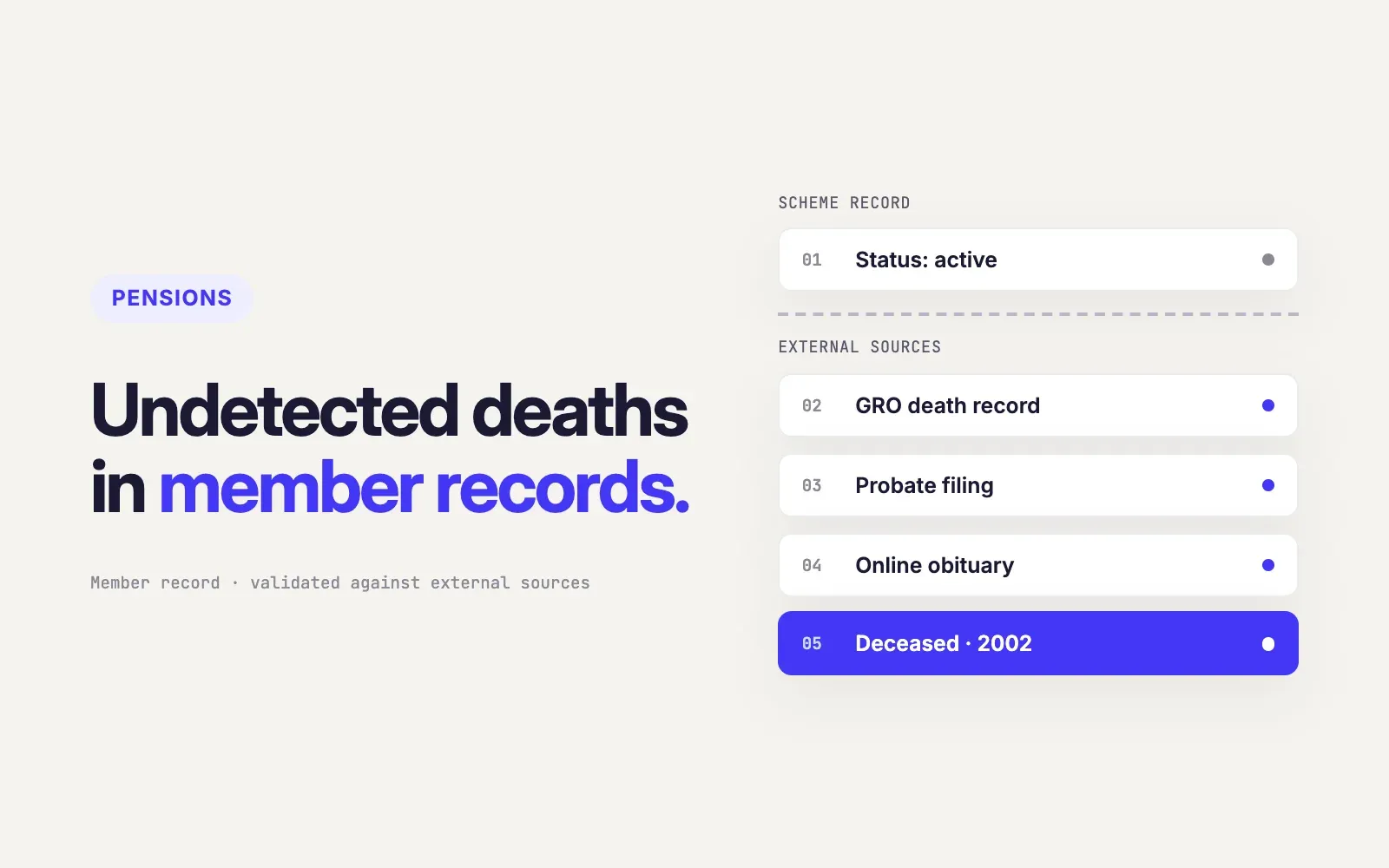
Unreported deaths provide the clearest example. A member may still be recorded as living when they have died. Once confirmed, the administrator must establish what obligations remain, including any survivor pension or lump sum. The resulting position may differ from the benefits originally included in the pricing data.
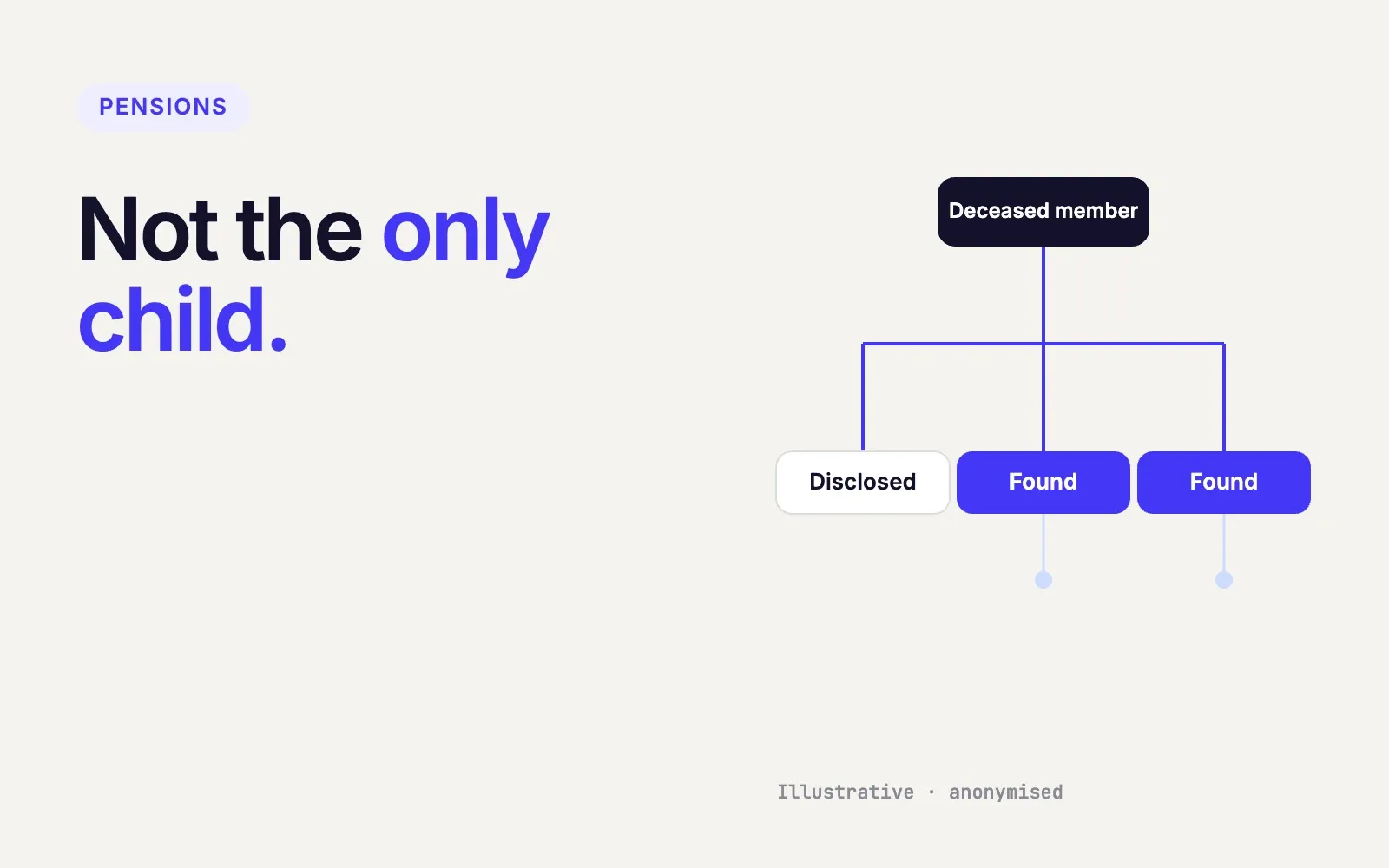
Spouse and dependant information can also be financially relevant where survivor benefits are payable. The existence of an eligible dependant and relevant age information can inform the assessment of future payments.
Aon’s research on dependant assumptions confirms their importance for bulk annuity pricing. It also cautions against treating a tracing result of “single” as proof that no eligible dependant exists. Relationship evidence needs interpretation against the scheme’s eligibility rules.
Incorrect identity attributes, such as a date of birth, warrant investigation where they affect the assessment of benefits or future payments. A name change may help resolve the correct identity even if the name itself has no direct pricing effect.
Current contact details and international tracing support these checks by helping locate the correct person and obtain confirmation. Their commercial value comes through the financially relevant questions they help resolve.
Why look beyond records already marked as incomplete?
An exception list reflects issues the scheme already knows about. It does not necessarily capture every discrepancy relevant to an insurance transaction.
A hypothetical deferred member may have a full name, date of birth and address on file, yet have died since the last update. Another member’s relationship information may have been accurate when collected but require a more recent check for the intended transaction.
Population-wide screening applies agreed checks across the membership, including records that appear complete. It can then direct deeper investigation towards potential discrepancies and unresolved questions.
The scope should build on existing work. Trustees should ask which groups have already been checked, when, against which sources and with what unresolved results. Deferred and overseas members deserve explicit consideration where existing controls provide different coverage.
How does a finding become information an insurer can use?
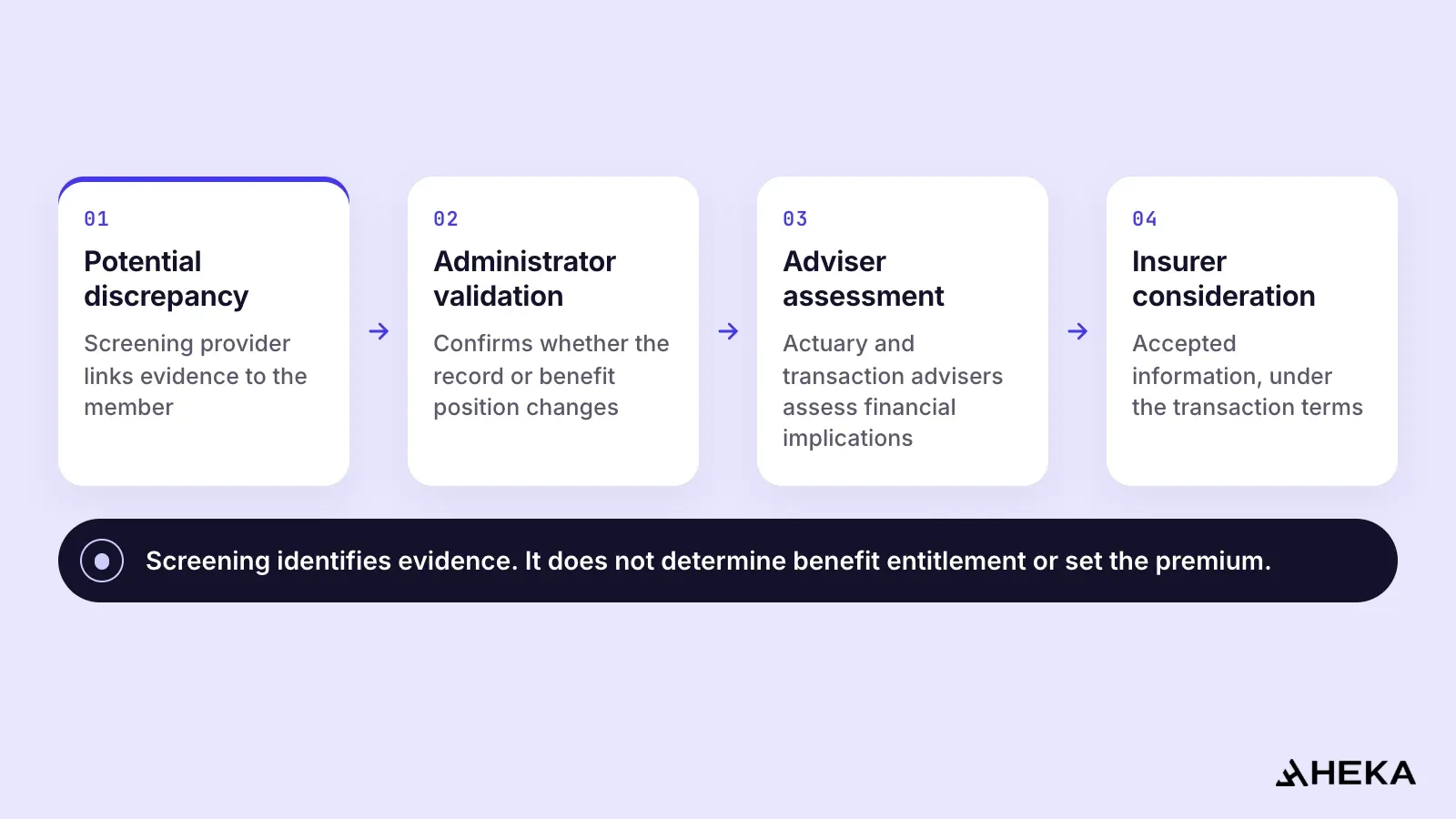
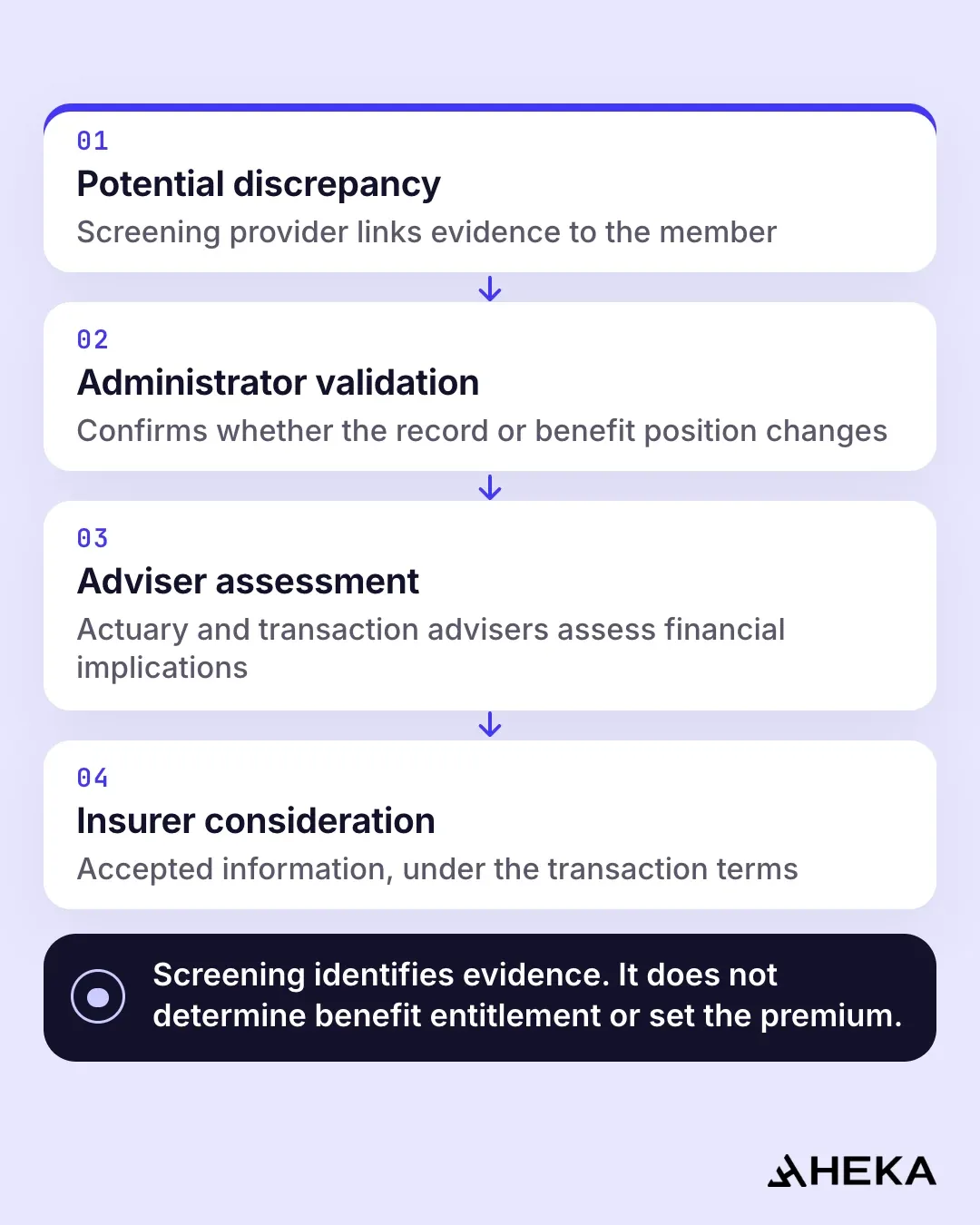
Screening identifies evidence; it does not determine benefit entitlement or set the premium. A practical route from discovery to pricing needs to be agreed before the exercise begins.
First, the provider identifies a potential discrepancy and links the evidence to the correct member. Next, the administrator validates the finding and establishes whether the record or benefit position should change. The actuary and transaction advisers assess the financial implications. The insurer then considers the accepted information under the transaction terms.
Each finding should show what differs from the record, supporting evidence, relevant dates, unresolved uncertainty and the required next action. Confirmed information should be distinguished from leads requiring investigation.
A search returning no mortality evidence does not establish that someone is alive. Finding a relative does not establish entitlement to a survivor pension. Those distinctions protect the quality of the eventual pricing inputs.
When can validated findings still influence the premium?
Before a buy-in, work backwards from the pricing data deadline. Allow time for validation, member contact where needed and adviser review. Identifying a useful discrepancy too late can limit its immediate value.
For a scheme already moving from buy-in to buyout, the relevant question is how updated information is treated under the existing contract. Changes may affect a balancing premium, but their treatment depends on the agreed terms, effective dates and nature of the update.
Ask the transaction adviser which validated findings could affect the initial or balancing premium, what evidence the insurer requires and by when it must be accepted. This connects the screening scope to a concrete financial decision.
How should trustees assess whether screening is worth doing?
The business case should combine the potential financial significance of findings with the cost of screening and remediation. Start by identifying what additional coverage or evidence the exercise would provide beyond existing controls.
Then agree how results will be assessed. Raw matches and updated contact details are not measures of premium savings. More useful measures include validated changes to relevant records, their assessed liability implications and the insurer’s treatment of those changes.
The effect can move in either direction. Identifying a previously unrecorded eligible dependant may increase the obligations recognised. Confirming an unreported death may reduce some expected payments while leaving survivor benefits to insure. Any savings estimate must account for the full benefit position.
How can Heka support population-wide screening?
Heka’s pension member intelligence supports mortality identification, identity validation, record restoration and next-of-kin discovery in the UK and internationally. These capabilities help investigate the people and relationships behind scheme records.
Applied across a membership, they can surface discrepancies for administrators and advisers to validate and assess for financial relevance. This adds a current evidence layer to existing data preparation and supports targeted follow-up where questions remain.
The next step is to identify which member uncertainties could matter to your transaction and agree how resolving them would enter the pricing process.
Speak to Heka about population-wide screening ahead of your scheme’s insurance transaction.