
Credit Risk Signals You Can Trust.





What You Can Do
with HEKA




How It Works
Existing Customer Record
Name, ID, date of birth, city — even if incomplete.

Live Data Extraction
Heka scans the open web for real-time behavioural, reputational, and relational signals.

AI-Powered Signal Structuring
Our AI parses noise into patterns, turning raw data into clear signals that reveal risk factors and anomalies — with full traceability.

Actionable, Traceable Output
A structured, explainable result — with indicators showing whether the profile is:
- No risk factor found
- Needs Underwriter Review
- Critical

We return only what you need — clear, evidence-based results, with links to source.
Powered by
Heka’s Identity Intelligence Engine


sources



Explore More Resources
Button Text
The Modern Fraud Stack: How Decisions Actually Get Made (and Where They Break)
An enterprise-grade fraud stack is not a product. It is a latency-constrained decisioning system in which multiple layers – data collection, identity validation, enrichment, scoring, and decisioning – operate as a single flow. In most transaction environments, that entire loop runs in under 300 milliseconds for transaction decisions, and only marginally longer for onboarding.
The challenge is not assembling the stack. Most institutions already have the core components in place, often across multiple vendors and internal systems. The challenge is understanding how those components interact in practice – and where the system produces decisions that appear well-supported, but are not.
How Fraud Decisions Are Produced
A fraud decision is not generated by a single model or rule. It is the result of a sequence of stages, each contributing a different type of signal or constraint.
At a high level, the system collects observable signals, validates identity claims, enriches those signals with external data, applies probabilistic scoring, enforces deterministic rules, and aggregates all outputs into a final decision. Cases that fall outside clear thresholds are escalated, and outcomes are fed back into the system to continuously refine performance.
This flow is consistent across financial institutions, even where implementation details differ . What varies is the relative strength of each layer, and the degree to which each one contributes meaningful signal to the final decision.
The 8 Layers of the Fraud Stack
In practice, this decisioning flow can be broken down into eight functional layers:
1. Signal Collection
The system captures all observable inputs at the point of interaction, including device fingerprinting, IP intelligence, behavioral biometrics, and identity data. These signals form the raw input for all downstream analysis.
2. Identity Verification (IDV)
Identity attributes are validated against trusted sources such as credit bureau headers, SSA records, and sanctions lists. This establishes whether the identity exists and meets regulatory requirements.
3. Data Enrichment
External data sources are used to expand the identity profile. This includes email intelligence, phone intelligence, address validation, and consortium-based signals that provide additional context beyond the initial claim.
4. Risk Scoring
Machine learning models transform raw and enriched signals into probabilistic risk scores. These models typically target specific fraud types, including application fraud, synthetic identity fraud, and account takeover.
5. Rules Engine
Deterministic rules enforce policy and known fraud patterns. These include hard blocks (e.g., sanctions matches), velocity thresholds, and mismatch conditions that cannot be fully captured by models.
6. Orchestration & Decisioning
All signals, model outputs, and rule evaluations are aggregated into a final decision – approve, review, or decline – through a centralized decisioning layer.
7. Step-Up & Case Management
Cases that fall into intermediate risk bands are escalated through additional verification (e.g., biometric checks, OTP) or routed to human investigation workflows.
8. Feedback & Model Governance
Confirmed fraud outcomes, false positives, and analyst decisions are fed back into the system to retrain models, refine rules, and monitor performance over time.
This architecture is broadly consistent across the industry. The presence of these layers, however, does not guarantee effective decisioning.
A Practical View of Where Each Layer Contributes (and Where It Breaks)
The following simplified view highlights how each layer contributes to the final decision, and where its limitations typically emerge:

This view is intentionally reductive. Its purpose is not to describe the system exhaustively, but to make visible where signal strength and decision confidence can diverge.
Where Modern Fraud Stacks Fail
Failures rarely occur because a layer is absent. They occur when a layer produces an output that appears sufficient, but lacks underlying depth.
An identity may pass bureau and SSA validation, present no device or velocity risk, and return acceptable enrichment signals. Yet the identity may still lack coherence across time – no consistent footprint, no reinforcing signals, and no evidence of persistence.
This is the central gap.
Most stacks are effective at confirming that an identity exists. Many can confirm that a user is physically present. Far fewer can determine whether the identity behaves like a reliable individual over time.
Structural Drivers of These Gaps
These limitations are not purely technical. They are structural.
Latency constraints limit the ability to incorporate deeper or slower data sources. Scale requires reliance on generalized models rather than case-specific analysis. Cost and conversion pressures reduce tolerance for additional friction or enrichment calls.
As a result, systems tend to emphasize:
- structural validation (existence)
- reactive signals (prior exposure)
Both are necessary. Neither is sufficient to fully resolve identity risk.
Why Fraud Stacks Differ in Practice
The “perfect” fraud stack is a myth. In practice, every stack reflects a set of trade-offs – between latency, cost, scale, and risk tolerance. Different institutions prioritize different parts of the system:

From Architecture to Evaluation
Understanding the structure of a fraud stack is necessary, but not sufficient. The more important task is evaluating how the stack behaves under real conditions.
Key questions include:
- Which layers are driving final decisions?
- Where is the system relying on structural validation alone?
- Which signals appear present, but are not materially influencing outcomes?
Fraud does not typically exploit missing components. It exploits the assumptions created by partial signal coverage.
Next: Evaluating the Stack in Practice
This report provides a structural view of the modern fraud stack. In the accompanying evaluation guide, we extend this framework to:
- assess the relative strength of each layer
- identify signal gaps and over-dependencies
- map vendor capabilities across the stack
- and isolate the conditions under which structurally valid identities continue to pass controls
Follow us to be notified when the full evaluation guide is released.

The Identity Pivot: Why 2026 is the Year We Stop Fighting AI with AI
The digital trust ecosystem has reached a breaking point. For the last decade, the industry’s defense strategy was built on a simple premise: detecting anomalies in a sea of legitimate behavior. But as we enter 2026, the mechanics of fraud have fundamentally inverted.
With global scam losses crossing $1 trillion and deepfake attacks surging by 3,000%, the line between the authentic and the synthetic has been erased. We are now witnessing the birth of "autonomous fraud" – a landscape where barriers to entry have vanished, and the guardrails are gone.
At Heka, we believe we have reached a critical pivot point. The industry must move beyond the futile arms race of trying to outpace generative models by simply using AI to detect AI. The new objective for heads of fraud and risk leaders is not just detecting attacks; it is verifying life.
Here is how the landscape is shifting in 2026, and why "context" is the only defense left that scales.
The Industrialization of Deception
The most dangerous shift in 2026 is the democratization of high-end attack vectors. What was once the domain of sophisticated syndicates is now accessible to anyone with an internet connection.
This "Fraud as a Service" economy has lowered barriers to entry so drastically that 34% of consumers now report seeing offers to participate in fraud online – an alarmingly steep 89% year-over-year increase.
But the true threat lies in automation. We are witnessing the rise of the "Industrial Smishing Complex." According to insights from the Secret Service, we are seeing SIM farms capable of sending 30 million messages per minute – enough to text every American in under 12 minutes.
This is not just spam; it is a volume game powered by AI agents that never sleep. In the "Pig Butchering 2.0" model, automated scam centers are replacing human labor with AI systems that handle the "hook and line" conversations entirely autonomously. When a single bad actor can launch millions of attacks from a one-bedroom apartment, volume becomes a weapon that overwhelms traditional defenses.
The Rise of the "Shapeshifter" and "Dust" Attacks
Traditional fraud prevention relies on identifying outliers – high-value transactions or unusual behaviors. In 2026, fraudsters have inverted this logic using two distinct strategies:
1. The Shapeshifting Agent
Static rules fail against dynamic adversaries. We are now facing "shapeshifting" AI agents that do not follow pre-defined malware scripts. Instead, these agents learn from friction in real-time. If a transaction is declined, the AI adjusts its tactics instantly, using the rejection data to "shapeshift" into a new attack vector. As noted by risk experts, these agents autonomously navigate trial-and-error loops, rendering static rules useless.
2. "Dust" Trails and Horizontal Attacks
While banks watch for the "big heist," fraud rings are executing "horizontal attacks." By skimming small amounts – often around $50 – from thousands of victims simultaneously, attackers create "dust trails" that stay below the investigation thresholds of major institutions.
Data from Sardine.AI indicates that fraud rings are now using fully autonomous systems to execute these attacks across hundreds of merchants simultaneously. Viewed in isolation, a single $50 charge looks like a normal transaction. It is only when viewed through the lens of web intelligence –seeing the shared infrastructure across the wider web – that the attack becomes visible.
The "Back to Branch" Regression
Perhaps the most alarming trend in 2026 is the erosion of confidence in digital channels. Because AI-generated identities and deepfakes have reached such sophistication, 75% of financial institutions admit their verification technology now produces inconsistent results.
This failure has triggered a defensive regression: the return to physical branches. Gartner estimates that 30% of enterprises no longer trust biometrics alone, leading some banks to demand customers appear in person for identity proofing.
While this stops the immediate bleeding, it is a strategic failure. Forcing customers back to the branch introduces massive friction without solving the core problem. As industry experts note, if a teller reviews a driver's license "as if it's 1995" while facing a fraudster with perfect AI-generated documentation, we are merely adding inconvenience, not security.
The Solution: Context is the New Identity
The issue facing our industry is not a failure of digital identity itself; it is a failure of context.
Trust is fragile when it relies on a single signal, like a document scan or a selfie. In an AI-versus-AI world, seeing is no longer believing. However, while AI can fabricate a driver's license or a video feed, it consistently fails to recreate the messy, organic digital footprint of a real human being.
To survive the 2026 threat landscape, organizations must pivot toward:
1. Web Intelligence: Linking signals together to see the wider web of interactions rather than isolated events.
2. Long-Term, Consistent Presence: analyzing the continuity of an identity over time. Real humans have history. Synthetic identities, no matter how polished, lack the depth of a long-term digital existence.
3. Cross-Channel Consistency: Looking for the shared infrastructure and overlapping identities that horizontal attacks inevitably leave behind.
The 2026 Takeaway
The future offers a clear path forward. Fraud prevention is no longer about beating a single control – it is about bridging the gaps between them.
While identity and behavior are easier to fake in isolation, the real advantage lies in the complexity of real-world signals. These are the signals that remain expensive to manufacture at scale. Organizations that embrace this context-driven approach will do more than just stop the $1 trillion wave of autonomous fraud; they will unlock a seamless experience where trust is automatic.
Stay informed. Stay adaptive. Stay ahead.
At Heka Global, our platform delivers real-time, explainable intelligence from thousands of global data sources to help fraud teams spot non-human patterns, identity inconsistencies, and early lifecycle divergence long before losses occur.
.png)
Why Did So Many Identity Controls Fail in 2025?
2025 marked a turning point in digital identity risk. Fraud didn’t simply become more sophisticated – it became industrialized. What emerged across financial institutions was not a new fraud “type,” but a new production model: fraud operations shifted from human-led tactics to system-led pipelines capable of assembling identities, navigating onboarding flows, and adapting to defenses at machine speed.
Synthetic identities, account takeover attempts, and document fraud didn’t just rise in volume; they became more operationally consistent, more repeatable, and more automated. Fraud rings began functioning less like informal criminal networks and more like tech companies: deploying AI agents, modular tooling, continuous integration pipelines, and automated QA-style probing of institutional controls.
This is why so many identity controls failed in 2025. They were calibrated for adversaries who behave like people.
Automation Became the Default Operating Mode
The most consequential development of 2025 was the normalization of autonomous or semi-autonomous fraud workflows. AI agents began executing tasks traditionally requiring human coordination: assembling identity components, navigating onboarding flows, probing rule thresholds, and iterating on failures in real time. Anthropic’s September findings – documenting agentic AI gaining access to confirmed high-value targets – validated what fraud teams were already observing: the attacker is no longer just an individual actor but a persistent, adaptive system.
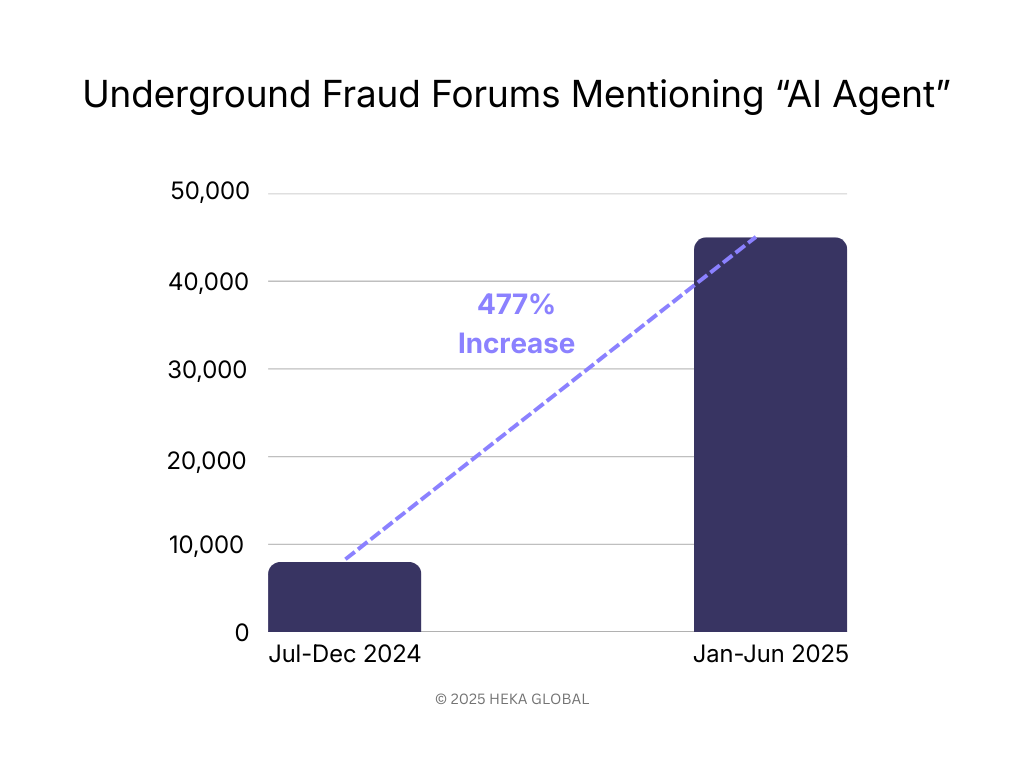
According to Visa, activity across their ecosystem shows clear evidence of an AI shift. Mentions of “AI Agent” in underground forums have surged 477%, reflecting how quickly fraudsters are adopting autonomous systems for social engineering, data harvesting, and payment workflows.
Operational consequences were immediate:
- Attempt volumes exceeded human-constrained detection models
- Timing patterns became too consistent for human-based anomaly rules
- Retries and adjustments became systematic rather than opportunistic
- Session structures behaved more like software than people
- Attacks ran continuously, unaffected by time zones, fatigue, or manual bottlenecks
Controls calibrated for human irregularity struggled against machine-level consistency. The threat model had shifted, but the control model had not.
Synthetic Identity Production Reached Industrial Scale
2025 also saw the industrialization of synthetic identity creation – driven by both generative AI and the rapid expansion of fraud-as-a-service (FaaS) marketplaces. What previously required technical skill or bespoke manual work is now fully productized. Criminal marketplaces provide identity components, pre-validated templates, and automated tooling that mirror legitimate SaaS workflows.
.jpg)
These marketplaces supply:
- AI-generated facial images and liveness-passing videos
- Country-specific forged document packs
- Pre-scraped digital footprints from public and commercial sources
- Bulk synthetic identity templates with coherent PII
- Automated onboarding scripts designed to work across popular IDV vendors
- APIs capable of generating thousands of synthetic profiles at once
- And more…
This ecosystem eliminated traditional constraints on identity fabrication. In North America, synthetic document fraud rose 311% year-on-year. Globally, deepfake incidents surged 700%. And with access to consumer data platforms like BeenVerified, fraud actors needed little more than a name to construct a plausible identity footprint.
The critical challenge was not just volume, but coherence: synthetic identities were often too clean, too consistent, and too well-structured. Legacy controls interpret clean data as low risk. But today, the absence of noise is often the strongest indicator of machine-assembled identity.
Because FaaS marketplaces standardized production, institutions began seeing near-identical identity patterns across geographies, platforms, and product types – a hallmark of industrialized fraud. Controls validated what “existed,” not whether it reflected a real human identity. That gap widened every quarter in 2025.
Where Identity Controls Reached Their Limits
As fraud operations industrialized, several foundational identity controls reached structural limits. These were not tactical failures; they reflected the fact that the underlying assumptions behind these controls no longer matched the behavior of modern adversaries.
Device intelligence weakened as attackers shifted to hardware
For years, device fingerprinting was a strong differentiator between legitimate users and automated or high-risk actors. This vulnerability was exposed by Europol’s Operation SIMCARTEL in October 2025, one of many recent cases where criminals used genuine hardware and SIM box technology, specifically 40,000 physical SIM cards, to generate real, high-entropy device signals that bypassed checks. Fraud rings moved from spoofing devices to operating them at scale, eroding the effectiveness of fingerprinting models designed to catch software-based manipulation.
Knowledge-based authentication effectively collapsed
With PII volume at unprecedented levels and AI retrieval tools able to surface answers instantly, knowledge-based authentication no longer correlated with human identity ownership. Breaches like the TransUnion incident in late August 2025, which exposed 4.4 million sensitive records, flood the dark web with PII. These events provide bad actors with the exact answers needed to bypass security questions, and when paired with AI retrieval tools, render KBA controls defenseless. What was once a fallback escalated into a near-zero-value signal.
Rules were systematically reverse-engineered
High-volume, automated adversarial probing enabled fraud actors to map rule thresholds with precision. UK Finance and Cifas jointly reported 26,000 ATO attempts engineered to stay just under the £500 review limit. Rules didn’t fail because they were poorly designed. They failed because automation made them predictable.
Lifecycle gaps remained unprotected
Most controls still anchor identity validation to isolated events – onboarding, large transactions, or high-friction workflows. Fraud operations exploited the unmonitored spaces in between:
- contact detail changes
- dormant account reactivation
- incremental credential resets
- low-value testing
Legacy controls were built for linear journeys. Fraud in 2025 moved laterally.
What 2026 Fraud Strategy Now Requires
The institutions that performed best in 2025 were not the ones with the most tools – they were the ones that recalibrated how identity is evaluated and how fraud is expected to behave. The shift was operational, not philosophical: identity is no longer an event to verify, but a system to monitor continuously.
Three strategic adjustments separated resilient teams from those that saw the highest loss spikes.
1. Treat identity as a longitudinal signal, not a point-in-time check
Onboarding signals are now the weakest indicators of identity integrity. Fraud prevention improved when teams shifted focus to:
- behavioral drift over time
- sequence patterns across user journeys
- changes in device, channel, or footprint lineage
- reactivation profiles on dormant accounts
Continuous identity monitoring is replacing traditional KYC cadence. The strongest institutions treated identity as something that must prove itself repeatedly, not once.
2. Incorporate external and open-web intelligence into identity decisions
Industrialized fraud exploits the gaps left by internal-only models. High-performing institutions widened their aperture and integrated signals from:
- digital footprint depth and entropy
- cross-platform identity reuse
- domain/phone/email lineage
- web presence maturity
- global device networks and associations
These signals exposed synthetics that passed internal checks flawlessly but could not replicate authentic, long-term human activity on the open web.
Identity integrity is now a multi-environment assessment, not an internal verification process.
3. Detect automation explicitly
Most fraud in 2025 exhibited machine-level regularity – predictable timing, optimized retries, stable sequences. Teams that succeeded treated automation as a primary signal, incorporating:
- micro-timing analysis
- session-structure profiling
- velocity and retry pattern detection
- non-human cadence modeling
Fraud no longer “looks suspicious”; it behaves systematically. Detection must reflect that.
4. Shift from tool stacks to orchestration
Fragmented fraud stacks produced fragmented intelligence. Institutions saw the strongest improvements when they unified:
- IDV
- behavioral analytics
- device and network intelligence
- OSINT and digital footprint context
- transaction and account-change data
into a single, coherent decision layer. Data orchestration provided two outcomes legacy stacks could not:
- Contextual scoring – identities evaluated across signals, not in isolation
- Consistent policy application – reducing false positives and operational drag
The shift isn’t toward more controls; it is toward coordination.
Closing Perspective
Identity controls didn’t fail in 2025 because institutions lacked capability. They failed because the models underpinning those controls were anchored to a world where identity was stable, fraud was manual, and behavioral irregularity differentiated good actors from bad.
In 2025, identity became dynamic and distributed. Fraud became industrialized and system-led.
Institutions that recalibrate their approach now – treating identity as a living system, integrating external context, and unifying decisioning layers – will be best positioned to defend against the operational realities of 2026.
At Heka Global, our platform delivers real-time, explainable intelligence from thousands of global data sources to help fraud teams spot non-human patterns, identity inconsistencies, and early lifecycle divergence long before losses occur.

Heka Raises $14M to bring Real-Time Identity Intelligence to Financial Institutions
FOR IMMEDIATE RELEASE
Heka Raises $14M to bring Real-Time Identity Intelligence to Financial Institutions
Windare Ventures, Barclays and other institutional investors back Heka’s AI engine as financial institutions seek stronger defenses against synthetic fraud and identity manipulation.
New York, 15 July 2025
Consumer fraud is at an all-time high. Last year, losses hit $12.5 billion – a 38% jump year-over-year. The rise is fueled by burner behavior, synthetic profiles, and AI-generated content. But the tools meant to stop it – from credit bureau data to velocity models – miss what’s happening online. Heka was built to close that gap.
Inspired by the tradecraft of the intelligence community, Heka analyzes how a person actually behaves and appears across the open web. Its proprietary AI engine assembles digital profiles that surface alias use, reputational exposure, and behavioral anomalies. This helps financial institutions detect synthetic activity, connect with real customers, and act faster with confidence.
At the core of Heka’s web intelligence engine is an analyst-grade AI agent. Unlike legacy tools that rely on static files, scores, or blacklists, Heka’s AI processes large volumes of web data to produce structured outputs like fraud indicators, updated contact details, and contextual risk signals. In one recent deployment with a global payment processor, Heka’s AI engine caught 65% of account takeover losses without disrupting healthy user activity.
Heka is already generating millions in revenue through partnerships with banks, payment processors, and pension funds. Clients use Heka’s intelligence to support critical decisions from fraud mitigation to account management and recovery. The $14 million Series A round, led by Windare Ventures with participation by Barclays, Cornèr Banca, and other institutional investors, will accelerate Heka’s U.S. expansion and deepen its footprint across the UK and Europe.
“Heka’s offering stood out for its ability to address a critical need in financial services – helping institutions make faster, smarter decisions using trustworthy external data. We’re proud to support their continued growth as they scale in the U.S.” said Kester Keating, Head of US Principal Investments at Barclays.
Ori Ashkenazi, Managing Partner at Windare Ventures, added: “Identity isn’t a fixed file anymore. It’s a stream of behavior. Heka does what most AI can’t: it actually works in the wild, delivering signals banks can use seamlessly in workflows.”
Heka was founded by Rafael Berber, former Global Head of Equity Trading at Merrill Lynch; Ishay Horowitz, a senior officer in the Israeli intelligence community; and Idan Bar-Dov, a fintech and high-tech lawyer. The broader team includes intel analysts, data scientists, and domain experts in fraud, credit, and compliance.
“The credit bureaus were built for another era. Today, both consumers and risk live online. Heka’s mission is to be the default source of truth for this new digital reality – always-on, accurate, and explainable.” said Idan Bar-Dov, the Co-founder and CEO of Heka.
About Heka
Heka delivers web intelligence to financial services. Its AI engine is used by banks, payment processors, and pension funds to fill critical blind spots in fraud mitigation, credit-decision, and account recovery. The company was founded in 2021 and is headquartered in New York and Tel Aviv.
Press contact
Joy Phua Katsovich, VP Marketing | joy@hekaglobal.com