
Resources

The Modern Fraud Stack: How Decisions Actually Get Made (and Where They Break)
An enterprise-grade fraud stack is not a product. It is a latency-constrained decisioning system in which multiple layers – data collection, identity validation, enrichment, scoring, and decisioning – operate as a single flow. In most transaction environments, that entire loop runs in under 300 milliseconds for transaction decisions, and only marginally longer for onboarding.
The challenge is not assembling the stack. Most institutions already have the core components in place, often across multiple vendors and internal systems. The challenge is understanding how those components interact in practice – and where the system produces decisions that appear well-supported, but are not.
How Fraud Decisions Are Produced
A fraud decision is not generated by a single model or rule. It is the result of a sequence of stages, each contributing a different type of signal or constraint.
At a high level, the system collects observable signals, validates identity claims, enriches those signals with external data, applies probabilistic scoring, enforces deterministic rules, and aggregates all outputs into a final decision. Cases that fall outside clear thresholds are escalated, and outcomes are fed back into the system to continuously refine performance.
This flow is consistent across financial institutions, even where implementation details differ . What varies is the relative strength of each layer, and the degree to which each one contributes meaningful signal to the final decision.
The 8 Layers of the Fraud Stack
In practice, this decisioning flow can be broken down into eight functional layers:
1. Signal Collection
The system captures all observable inputs at the point of interaction, including device fingerprinting, IP intelligence, behavioral biometrics, and identity data. These signals form the raw input for all downstream analysis.
2. Identity Verification (IDV)
Identity attributes are validated against trusted sources such as credit bureau headers, SSA records, and sanctions lists. This establishes whether the identity exists and meets regulatory requirements.
3. Data Enrichment
External data sources are used to expand the identity profile. This includes email intelligence, phone intelligence, address validation, and consortium-based signals that provide additional context beyond the initial claim.
4. Risk Scoring
Machine learning models transform raw and enriched signals into probabilistic risk scores. These models typically target specific fraud types, including application fraud, synthetic identity fraud, and account takeover.
5. Rules Engine
Deterministic rules enforce policy and known fraud patterns. These include hard blocks (e.g., sanctions matches), velocity thresholds, and mismatch conditions that cannot be fully captured by models.
6. Orchestration & Decisioning
All signals, model outputs, and rule evaluations are aggregated into a final decision – approve, review, or decline – through a centralized decisioning layer.
7. Step-Up & Case Management
Cases that fall into intermediate risk bands are escalated through additional verification (e.g., biometric checks, OTP) or routed to human investigation workflows.
8. Feedback & Model Governance
Confirmed fraud outcomes, false positives, and analyst decisions are fed back into the system to retrain models, refine rules, and monitor performance over time.
This architecture is broadly consistent across the industry. The presence of these layers, however, does not guarantee effective decisioning.
A Practical View of Where Each Layer Contributes (and Where It Breaks)
The following simplified view highlights how each layer contributes to the final decision, and where its limitations typically emerge:

This view is intentionally reductive. Its purpose is not to describe the system exhaustively, but to make visible where signal strength and decision confidence can diverge.
Where Modern Fraud Stacks Fail
Failures rarely occur because a layer is absent. They occur when a layer produces an output that appears sufficient, but lacks underlying depth.
An identity may pass bureau and SSA validation, present no device or velocity risk, and return acceptable enrichment signals. Yet the identity may still lack coherence across time – no consistent footprint, no reinforcing signals, and no evidence of persistence.
This is the central gap.
Most stacks are effective at confirming that an identity exists. Many can confirm that a user is physically present. Far fewer can determine whether the identity behaves like a reliable individual over time.
Structural Drivers of These Gaps
These limitations are not purely technical. They are structural.
Latency constraints limit the ability to incorporate deeper or slower data sources. Scale requires reliance on generalized models rather than case-specific analysis. Cost and conversion pressures reduce tolerance for additional friction or enrichment calls.
As a result, systems tend to emphasize:
- structural validation (existence)
- reactive signals (prior exposure)
Both are necessary. Neither is sufficient to fully resolve identity risk.
Why Fraud Stacks Differ in Practice
The “perfect” fraud stack is a myth. In practice, every stack reflects a set of trade-offs – between latency, cost, scale, and risk tolerance. Different institutions prioritize different parts of the system:

From Architecture to Evaluation
Understanding the structure of a fraud stack is necessary, but not sufficient. The more important task is evaluating how the stack behaves under real conditions.
Key questions include:
- Which layers are driving final decisions?
- Where is the system relying on structural validation alone?
- Which signals appear present, but are not materially influencing outcomes?
Fraud does not typically exploit missing components. It exploits the assumptions created by partial signal coverage.
Next: Evaluating the Stack in Practice
This report provides a structural view of the modern fraud stack. In the accompanying evaluation guide, we extend this framework to:
- assess the relative strength of each layer
- identify signal gaps and over-dependencies
- map vendor capabilities across the stack
- and isolate the conditions under which structurally valid identities continue to pass controls
Follow us to be notified when the full evaluation guide is released.

Heka Raises $14M to bring Real-Time Identity Intelligence to Financial Institutions
FOR IMMEDIATE RELEASE
Heka Raises $14M to bring Real-Time Identity Intelligence to Financial Institutions
Windare Ventures, Barclays and other institutional investors back Heka’s AI engine as financial institutions seek stronger defenses against synthetic fraud and identity manipulation.
New York, 15 July 2025
Consumer fraud is at an all-time high. Last year, losses hit $12.5 billion – a 38% jump year-over-year. The rise is fueled by burner behavior, synthetic profiles, and AI-generated content. But the tools meant to stop it – from credit bureau data to velocity models – miss what’s happening online. Heka was built to close that gap.
Inspired by the tradecraft of the intelligence community, Heka analyzes how a person actually behaves and appears across the open web. Its proprietary AI engine assembles digital profiles that surface alias use, reputational exposure, and behavioral anomalies. This helps financial institutions detect synthetic activity, connect with real customers, and act faster with confidence.
At the core of Heka’s web intelligence engine is an analyst-grade AI agent. Unlike legacy tools that rely on static files, scores, or blacklists, Heka’s AI processes large volumes of web data to produce structured outputs like fraud indicators, updated contact details, and contextual risk signals. In one recent deployment with a global payment processor, Heka’s AI engine caught 65% of account takeover losses without disrupting healthy user activity.
Heka is already generating millions in revenue through partnerships with banks, payment processors, and pension funds. Clients use Heka’s intelligence to support critical decisions from fraud mitigation to account management and recovery. The $14 million Series A round, led by Windare Ventures with participation by Barclays, Cornèr Banca, and other institutional investors, will accelerate Heka’s U.S. expansion and deepen its footprint across the UK and Europe.
“Heka’s offering stood out for its ability to address a critical need in financial services – helping institutions make faster, smarter decisions using trustworthy external data. We’re proud to support their continued growth as they scale in the U.S.” said Kester Keating, Head of US Principal Investments at Barclays.
Ori Ashkenazi, Managing Partner at Windare Ventures, added: “Identity isn’t a fixed file anymore. It’s a stream of behavior. Heka does what most AI can’t: it actually works in the wild, delivering signals banks can use seamlessly in workflows.”
Heka was founded by Rafael Berber, former Global Head of Equity Trading at Merrill Lynch; Ishay Horowitz, a senior officer in the Israeli intelligence community; and Idan Bar-Dov, a fintech and high-tech lawyer. The broader team includes intel analysts, data scientists, and domain experts in fraud, credit, and compliance.
“The credit bureaus were built for another era. Today, both consumers and risk live online. Heka’s mission is to be the default source of truth for this new digital reality – always-on, accurate, and explainable.” said Idan Bar-Dov, the Co-founder and CEO of Heka.
About Heka
Heka delivers web intelligence to financial services. Its AI engine is used by banks, payment processors, and pension funds to fill critical blind spots in fraud mitigation, credit-decision, and account recovery. The company was founded in 2021 and is headquartered in New York and Tel Aviv.
Press contact
Joy Phua Katsovich, VP Marketing | joy@hekaglobal.com

Data. It's What's for Dinner.
What is data? Loosely defined, data is facts or statistics collected together for reference or analysis. That definition does a poor job of painting a picture to show you what data is, where you can find it, and what to do with it. It’s like the instructions competitors in “The Great British Bake-Off” get during their technical challenge, where they are told to “make bread” or “bake” and not given any additional information. But any collection operation that intends on being around for more than a few more months needs to know a lot more about data than that definition. They need to be eating it, sleeping with it, taking it to meet their parents.
Data should be influencing every decision you make - whom to call and when, what to put in the body or subject line of an email, where to put the “Make a Payment” button on your portal. Data has become a critical asset for making informed decisions and optimizing recovery strategies. As a company focused on helping organizations analyze their data, we’ve seen firsthand how leveraging the right information can drastically improve collection rates and operational efficiency. However, with the vast amount of data available, it can be challenging to identify which data points are truly essential to your collection operation. In this blog post, we'll explore the most important data points you should focus on, how AI in collections and predictive analytics can enhance their value, and provide actionable insights to help you take your collection strategies to the next level.
What makes this such a difficult topic is that this is very much a “your mileage may vary” type of situation. The data that you have access to and that is important to you is going to be different then the data that your peers and colleagues have access to and is important to them. It’s not exactly a snowflake situation, but the nuances and idiosyncrasies of different collection platforms and appetites for risk are going to change the quality and quantity of data inside a collection operation.
Generally speaking, here are some areas that will yield data you can put to good use. Some of this you may have access to and some of it you may not, but you can use this as a departure point.
Customer Financial Profile
- Credit score
- Income level
- Employment status
- Debt-to-income ratio
- Payment History
- Past payment patterns
- Frequency of late payments
- Average payment amounts
Communication Preferences
- Preferred contact methods
- Best times to reach the customer
- Response rates to different communication channels
Behavioral Data
- Website interactions
- Call center engagement
- Response to different collection approaches
Debt Information
- Type of debt
- Age of debt
Now that we've identified some key data points, let's explore how to effectively collect and utilize this information:
- Implement a robust CRM system: Centralize your data collection efforts by using a Customer Relationship Management (CRM) system tailored for the collections industry. This will help you track customer interactions, payment histories, and communication preferences in one place.
- Leverage alternative data sources: Look beyond traditional credit reports. Utilize public records, social media data, and other alternative sources to build a more comprehensive customer profile. For example, our web intelligence technology allows customers to access alternative data sources and build dynamic and comprehensive consumer profiles.
- Invest in data analytics tools: Employ machine learning for debt recovery to identify patterns and trends in your data that human analysis might miss. Learn how AI is revolutionizing debt recovery and helping companies identify crucial data patterns.
- Train your team on data literacy: Ensure that your collection agents understand the importance of accurate data entry and how to interpret data-driven insights.
Identifying the most important data points that help improve your productivity and efficiency is crucial to the success of your collection operation. Look at the data your operation is creating, talk to others about what data they are using, and work with your vendors to create reports that yield insightful and actionable insights you can put to work today.
.png)
Heka Joins Winmark’s PensionChair Network as Technical Partner
Heka has joined Winmark’s PensionChair Network as a Technical Partner.
Winmark convenes senior leaders across sectors through curated executive networks. The PensionChair Network brings together trustee boards and senior pensions professionals across the UK to share insight, address governance challenges, and strengthen scheme oversight.
As Technical Partner, Heka will provide member tracing, data enrichment, and identity verification capabilities to PensionChair members. This includes supporting schemes in resolving incomplete records, tracing overseas members, and addressing complex data quality challenges where traditional UK data sources may be limited.
Heka’s approach combines global open-source intelligence and structured digital footprint analysis to deliver verifiable, explainable outputs that trustees can rely on in fulfilling their governance responsibilities.
The partnership formalises Heka’s engagement with the PensionChair community and expands its collaboration with UK pension leaders.
Further information about upcoming sessions and member engagement will be shared through PensionChair communications and Heka's Linkedin.
Heka Raises $14M to bring Real-Time Identity Intelligence to Financial Institutions
FOR IMMEDIATE RELEASE
Heka Raises $14M to bring Real-Time Identity Intelligence to Financial Institutions
Windare Ventures, Barclays and other institutional investors back Heka’s AI engine as financial institutions seek stronger defenses against synthetic fraud and identity manipulation.
New York, 15 July 2025
Consumer fraud is at an all-time high. Last year, losses hit $12.5 billion – a 38% jump year-over-year. The rise is fueled by burner behavior, synthetic profiles, and AI-generated content. But the tools meant to stop it – from credit bureau data to velocity models – miss what’s happening online. Heka was built to close that gap.
Inspired by the tradecraft of the intelligence community, Heka analyzes how a person actually behaves and appears across the open web. Its proprietary AI engine assembles digital profiles that surface alias use, reputational exposure, and behavioral anomalies. This helps financial institutions detect synthetic activity, connect with real customers, and act faster with confidence.
At the core of Heka’s web intelligence engine is an analyst-grade AI agent. Unlike legacy tools that rely on static files, scores, or blacklists, Heka’s AI processes large volumes of web data to produce structured outputs like fraud indicators, updated contact details, and contextual risk signals. In one recent deployment with a global payment processor, Heka’s AI engine caught 65% of account takeover losses without disrupting healthy user activity.
Heka is already generating millions in revenue through partnerships with banks, payment processors, and pension funds. Clients use Heka’s intelligence to support critical decisions from fraud mitigation to account management and recovery. The $14 million Series A round, led by Windare Ventures with participation by Barclays, Cornèr Banca, and other institutional investors, will accelerate Heka’s U.S. expansion and deepen its footprint across the UK and Europe.
“Heka’s offering stood out for its ability to address a critical need in financial services – helping institutions make faster, smarter decisions using trustworthy external data. We’re proud to support their continued growth as they scale in the U.S.” said Kester Keating, Head of US Principal Investments at Barclays.
Ori Ashkenazi, Managing Partner at Windare Ventures, added: “Identity isn’t a fixed file anymore. It’s a stream of behavior. Heka does what most AI can’t: it actually works in the wild, delivering signals banks can use seamlessly in workflows.”
Heka was founded by Rafael Berber, former Global Head of Equity Trading at Merrill Lynch; Ishay Horowitz, a senior officer in the Israeli intelligence community; and Idan Bar-Dov, a fintech and high-tech lawyer. The broader team includes intel analysts, data scientists, and domain experts in fraud, credit, and compliance.
“The credit bureaus were built for another era. Today, both consumers and risk live online. Heka’s mission is to be the default source of truth for this new digital reality – always-on, accurate, and explainable.” said Idan Bar-Dov, the Co-founder and CEO of Heka.
About Heka
Heka delivers web intelligence to financial services. Its AI engine is used by banks, payment processors, and pension funds to fill critical blind spots in fraud mitigation, credit-decision, and account recovery. The company was founded in 2021 and is headquartered in New York and Tel Aviv.
Press contact
Joy Phua Katsovich, VP Marketing | joy@hekaglobal.com
.png)
ZEDRA and Heka Join Forces to Trace Missing Pension Members with AI
We’re proud to announce our partnership with ZEDRA Governance to help pension schemes tackle one of the sector’s biggest challenges: tracing missing members.
Following a successful pilot where Heka’s AI-powered tracing identified 50% of previously unreachable members, ZEDRA will now offer our technology to clients via a dedicated architecture, bringing scale and speed to both small and large schemes.
“Reuniting members with their full retirement benefits is a core fiduciary duty,” said Mark Stopard, Head of Proposition Development at ZEDRA Governance. “We’re excited to see the results of this initiative as part of our commitment to helping clients solve the issue of lost pensions.”
Heka's technology helps schemes locate current contact details, life status, and digital signals even when records are outdated or fragmented. By partnering with ZEDRA, we’re enabling better member engagement, reduced risk, and readiness for future reforms.
“Many of the toughest challenges in the pensions sector start with missing data,” said Max Lack, Business Development Manager at Heka. “Solving that unlocks everything else- from dashboard readiness to retirement adequacy.”
Read the full announcement on ZEDRA’s website.
.png)
Heka Now Live on NayaOne
We’re excited to announce that Heka is now live on NayaOne, the leading fintech and data marketplace for financial institutions.
Through the NayaOne platform, banks and insurers can now securely trial Heka’s external customer intelligence engine- accessing real-time, explainable insights for credit, fraud, onboarding, and more, all within a sandboxed environment.
This marks a major step in making Heka more accessible to innovation teams looking to accelerate decision-making with trustworthy, real-time web intelligence.
.png)
Dalriada Partners with Heka to Trace Pension Fraud Victims
We’re proud to support Dalriada Trustees in tracing victims of pension fraud using our AI-driven identity and contact resolution tools. The collaboration has already reunited members with their rightful benefits where traditional tracing methods failed. Read the full article published by Professional Pensions to learn more about how our partnership is helping deliver real outcomes in complex fraud scenarios.
👉 As featured in Professional Pensions
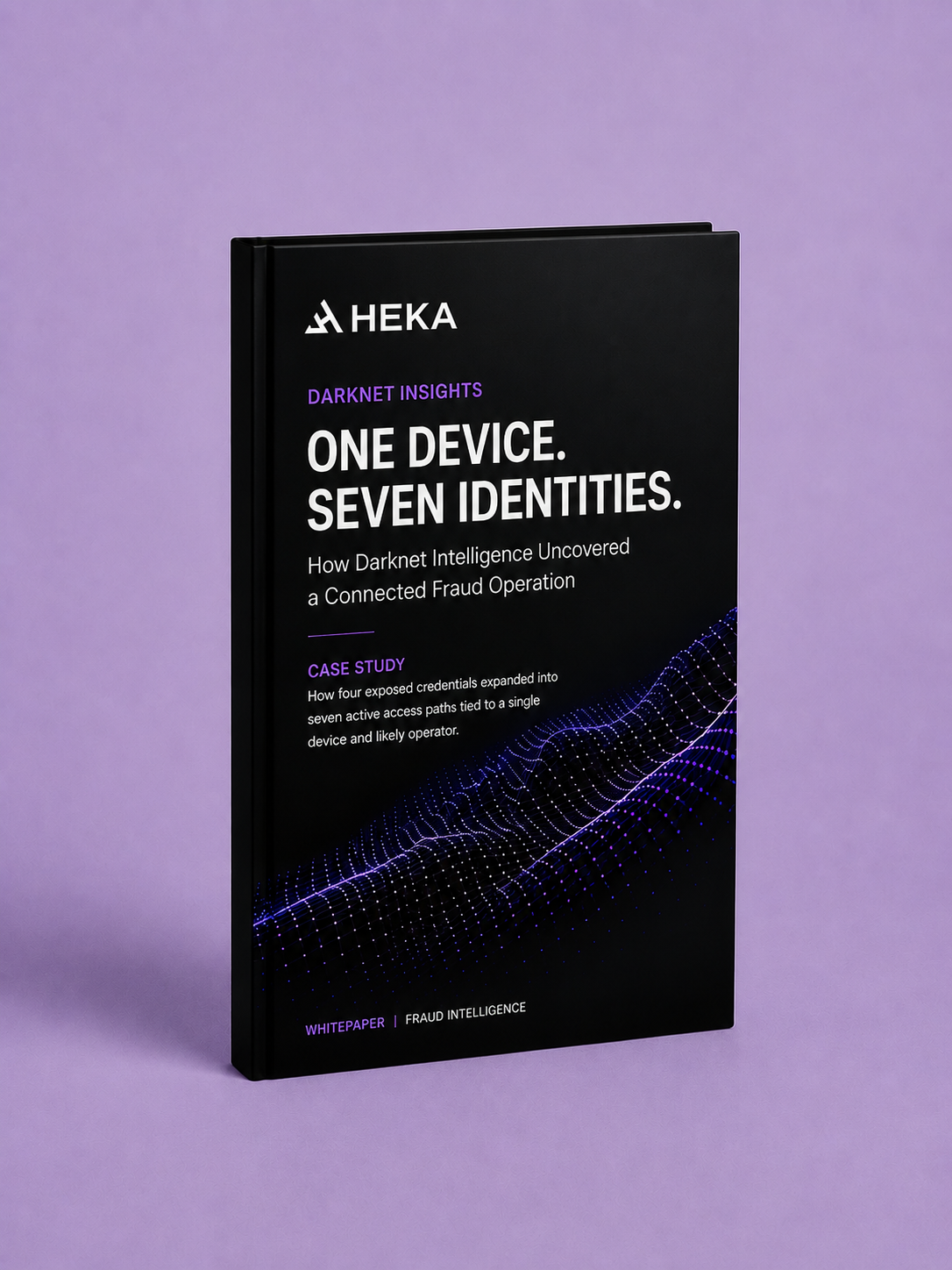
ONE DEVICE. SEVEN IDENTITIES.
Heading 1
Heading 2
Heading 3
Heading 4
Heading 5
Heading 6
Lorem ipsum dolor sit amet, consectetur adipiscing elit, sed do eiusmod tempor incididunt ut labore et dolore magna aliqua. Ut enim ad minim veniam, quis nostrud exercitation ullamco laboris nisi ut aliquip ex ea commodo consequat. Duis aute irure dolor in reprehenderit in voluptate velit esse cillum dolore eu fugiat nulla pariatur.
Block quote
Ordered list
- Item 1
- Item 2
- Item 3
Unordered list
- Item A
- Item B
- Item C
Bold text
Emphasis
Superscript
Subscript
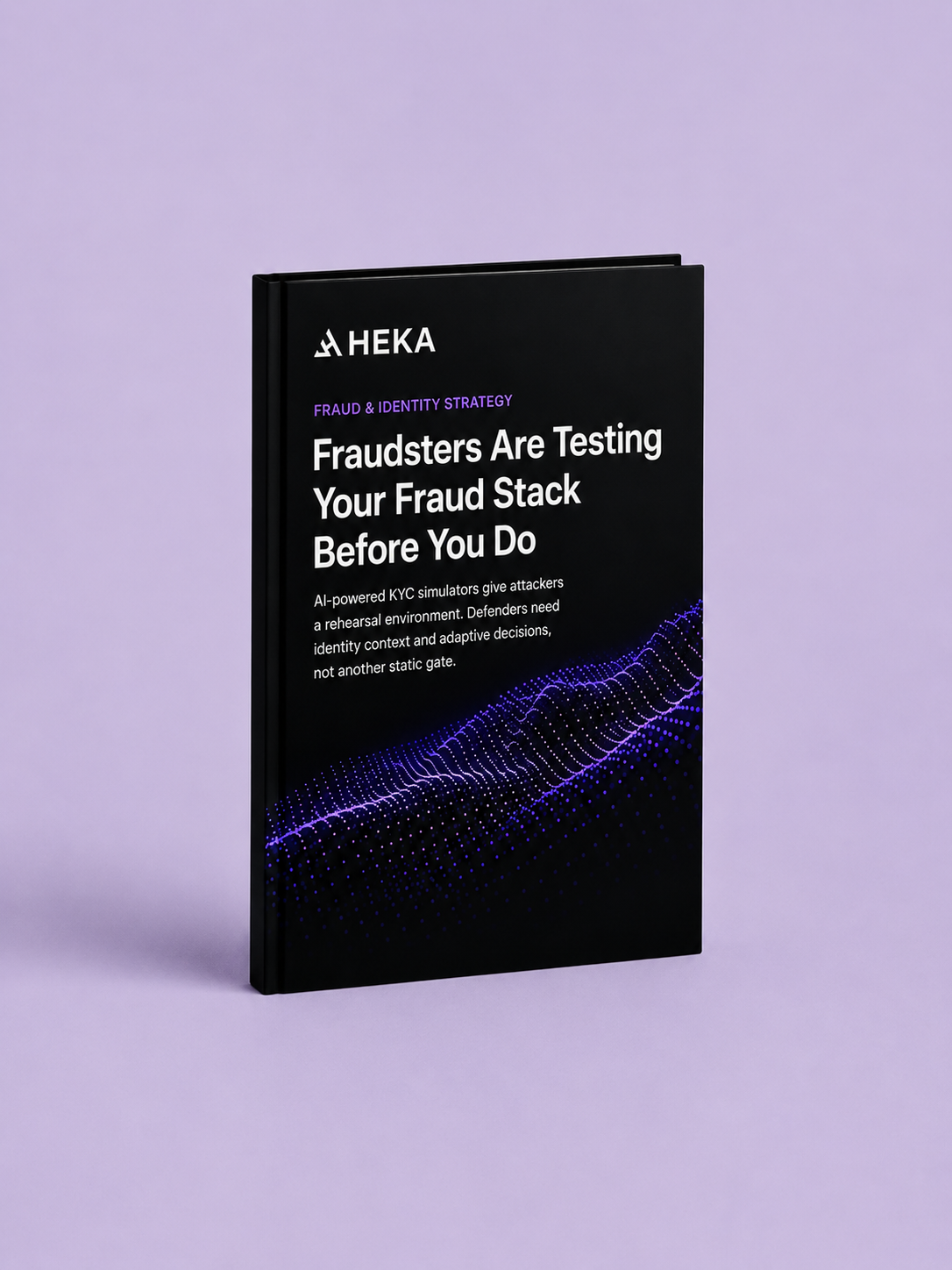
Fraudsters Are Testing Your Fraud Stack Before You Do
Heading 1
Heading 2
Heading 3
Heading 4
Heading 5
Heading 6
Lorem ipsum dolor sit amet, consectetur adipiscing elit, sed do eiusmod tempor incididunt ut labore et dolore magna aliqua. Ut enim ad minim veniam, quis nostrud exercitation ullamco laboris nisi ut aliquip ex ea commodo consequat. Duis aute irure dolor in reprehenderit in voluptate velit esse cillum dolore eu fugiat nulla pariatur.
Block quote
Ordered list
- Item 1
- Item 2
- Item 3
Unordered list
- Item A
- Item B
- Item C
Bold text
Emphasis
Superscript
Subscript
.png)
Account Takeover, Inside a Trusted Account
Heading 1
Heading 2
Heading 3
Heading 4
Heading 5
Heading 6
Lorem ipsum dolor sit amet, consectetur adipiscing elit, sed do eiusmod tempor incididunt ut labore et dolore magna aliqua. Ut enim ad minim veniam, quis nostrud exercitation ullamco laboris nisi ut aliquip ex ea commodo consequat. Duis aute irure dolor in reprehenderit in voluptate velit esse cillum dolore eu fugiat nulla pariatur.
Block quote
Ordered list
- Item 1
- Item 2
- Item 3
Unordered list
- Item A
- Item B
- Item C
Bold text
Emphasis
Superscript
Subscript
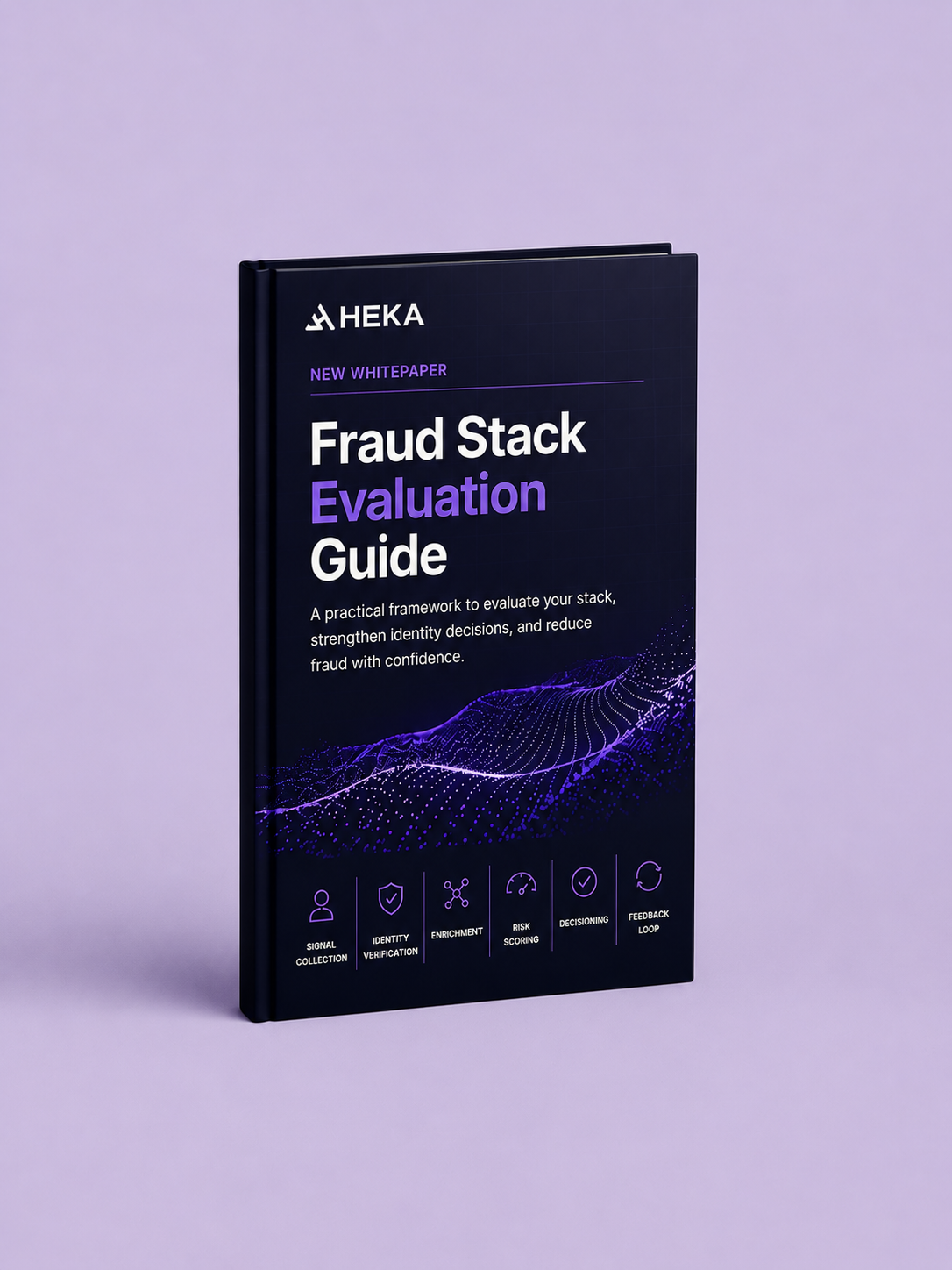
Rethinking the Fraud Stack: A Framework for Stronger Signals and Better Decisions
Heading 1
Heading 2
Heading 3
Heading 4
Heading 5
Heading 6
Lorem ipsum dolor sit amet, consectetur adipiscing elit, sed do eiusmod tempor incididunt ut labore et dolore magna aliqua. Ut enim ad minim veniam, quis nostrud exercitation ullamco laboris nisi ut aliquip ex ea commodo consequat. Duis aute irure dolor in reprehenderit in voluptate velit esse cillum dolore eu fugiat nulla pariatur.
Block quote
Ordered list
- Item 1
- Item 2
- Item 3
Unordered list
- Item A
- Item B
- Item C
Bold text
Emphasis
Superscript
Subscript

The ‘Klarna Glitch’ Wasn’t a Glitch: The Fraud Playbook That Bypassed Traditional KYC
Heading 1
Heading 2
Heading 3
Heading 4
Heading 5
Heading 6
Lorem ipsum dolor sit amet, consectetur adipiscing elit, sed do eiusmod tempor incididunt ut labore et dolore magna aliqua. Ut enim ad minim veniam, quis nostrud exercitation ullamco laboris nisi ut aliquip ex ea commodo consequat. Duis aute irure dolor in reprehenderit in voluptate velit esse cillum dolore eu fugiat nulla pariatur.
Block quote
Ordered list
- Item 1
- Item 2
- Item 3
Unordered list
- Item A
- Item B
- Item C
Bold text
Emphasis
Superscript
Subscript